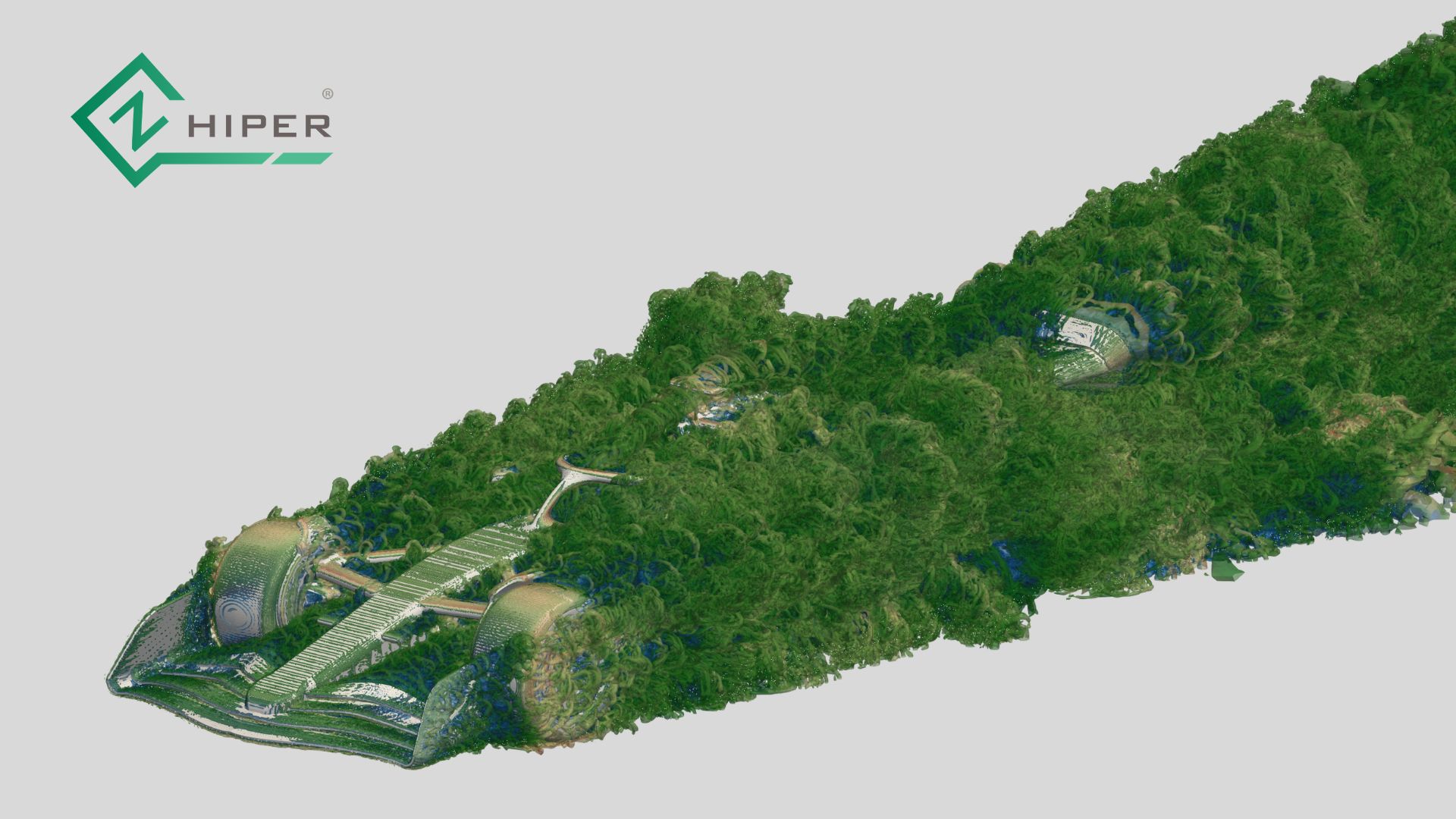
Zenotech announces the launch of HiPer, a scale-resolving computational fluid dynamics (CFD) solver that makes high-fidelity simulation fast, simple and affordable – accessible supercomputing without the need for an actual supercomputer. The new GPU-native solver cuts complex simulation times from weeks to hours, and mesh generation from weeks to minutes, putting high-fidelity turbulence prediction within reach of any engineering team.
Where traditional scale-resolving CFD has typically demanded specialist meshing expertise and access to large computing clusters, HiPer runs Large Eddy Simulations (LES) of extraordinary complexity on standard gaming-grade GPUs.
Real-world engineering results
Early benchmarks demonstrate the solver’s real-world efficiency:
- Meshing in minutes: A complex landing gear geometry meshing task that traditionally takes an engineer a week to prepare was ready to run in around five minutes.
- Ultra-light memory footprint: A massive 1.5-billion-cell simulation can be run on 4 GPUs with just 48GB of memory each – a fraction of what would conventionally be required for a mesh of that scale.
- Consumer hardware compatibility: Simulations that would once have required supercomputer time can now run on off-the-shelf hardware. LES simulations of more than 800 million cells run on as few as three consumer GPUs.
This combination of speed and hardware accessibility is driven by two innovations working together: an immersed boundary approach within Zenotech’s own ZM3 mesh generator, which removes almost all of the geometry clean-up that normally makes meshing complex shapes so time-consuming. Underneath, HiPer’s numerical algorithms are built specifically to run efficiently on GPUs, with a light memory footprint.
What does HiPer CFD stand for?
The name HiPer is short for High Performance, reflecting the core motivation behind its development. The Zenotech team wanted to build a high-performance, scale-resolving CFD solver that engineers could point at virtually any fluid dynamics problem without being bottlenecked by hardware.
How can HiPer CFD be used?
HiPer is optimised to predict the fine-scale turbulent flows that are critical to aero-acoustics, aerospace and automotive design, and has also been proven on built-environment cases, accurately capturing unsteady, time-varying airflow at street level around buildings.
As HiPer strips away the traditional complexity of CFD, onboarding is straightforward and designed to match the product’s ease of use. Zenotech has already had secondary school pupils running their own successful HiPer simulations within a few hours of starting out.
To ensure accessibility, Zenotech is bypassing traditional, restrictive per-core licensing. HiPer is launching an unlimited enterprise subscription model that grants unlimited usage across an entire organisation – removing the hardware bottlenecks from supercomputer-class simulation for engineering teams of all sizes.
Fast, accessible supercomputing
Mark Allan, Product Lead HiPer & ZM3, at Zenotech, said:
“I’m most proud of the process of HiPer. You can take a geometry, mesh it easily, create traditionally huge meshes, run on a single GPU and quickly get accurate, stunning results and visuals without a supercomputer. As one user told us, ‘it’s like CFD, just not as we know it.'”
Oliver Darbyshire, Lead CFD Engineer at Zenotech, added:
“By making the process this fast and accessible, the real skill is no longer in using the software, it’s in interpreting the results, which is where engineers actually add value. Combined with our disruptive, unlimited subscription model, users are actively encouraged to use the tool as much as they want without worrying about escalating costs.”
All data outputs are delivered in the open-source HDF5 format, ensuring seamless integration into existing downstream engineering workflows. To help teams experience HiPer’s capabilities, Zenotech is currently offering a limited time complimentary trial access.
For more information or to request a trial, visit the HiPer CFD website.