How can we make automotive CFD predictions more accurate? And what role will AI and machine learning play in the future?
These were among the key questions explored at the 5th Automotive CFD Prediction Workshop (AutoCFD5), held at DAMA Technopole in Bologna in October. Zenotech’s Lead CFD Engineer, Oliver Darbyshire, joined researchers and engineers from academia and the automotive industry to share insights and explore the latest developments in CFD.
Advancing automotive CFD through collaboration
The 5th Automotive CFD Prediction Workshop continues a community-wide initiative to evaluate how accurately CFD codes predict airflow around road-car geometries.
Participants work with common geometries, boundary conditions and computational meshes, allowing results to be compared directly. The findings help inform practical guidance for the automotive sector, from turbulence modelling and meshing strategies to numerical schemes.
With participation from industry and academia, the workshop provides a valuable opportunity to share findings, discuss challenges and shape the future of automotive CFD.
At Zenotech, we’re big believers in this collaborative approach. Sharing what works, as well as what doesn’t, is essential to advancing CFD technology and improving simulation accuracy.
AI, Machine Learning and Auto CFD
This year’s test cases build on the benchmark configurations established for AutoCFD4. AI and machine learning were a bigger focus this year, with model architectures evaluated against a common training set, the open-source DrivAerML dataset. The increase in AI/ML activity highlighted the potential of these technologies to influence the future of car CFD simulation.
Another theme apparent at the workshop was the increased use of Wall-Modelled LES and the employment of GPUs to improve solver run times, with these previously expensive computations becoming more widely employed in industry.
The programme also featured a range of interesting technical presentations, including a panel discussion exploring the future CFD needs of the automotive industry.
Exploring the test cases with HiPer
Zenotech have previously run both the workshop test cases using HiPer, our powerful, scale-resolving CFD solver. HiPer delivers supercomputer-level CFD performance on a desktop, making high-fidelity simulations more accessible.
Explore our results in two case studies:
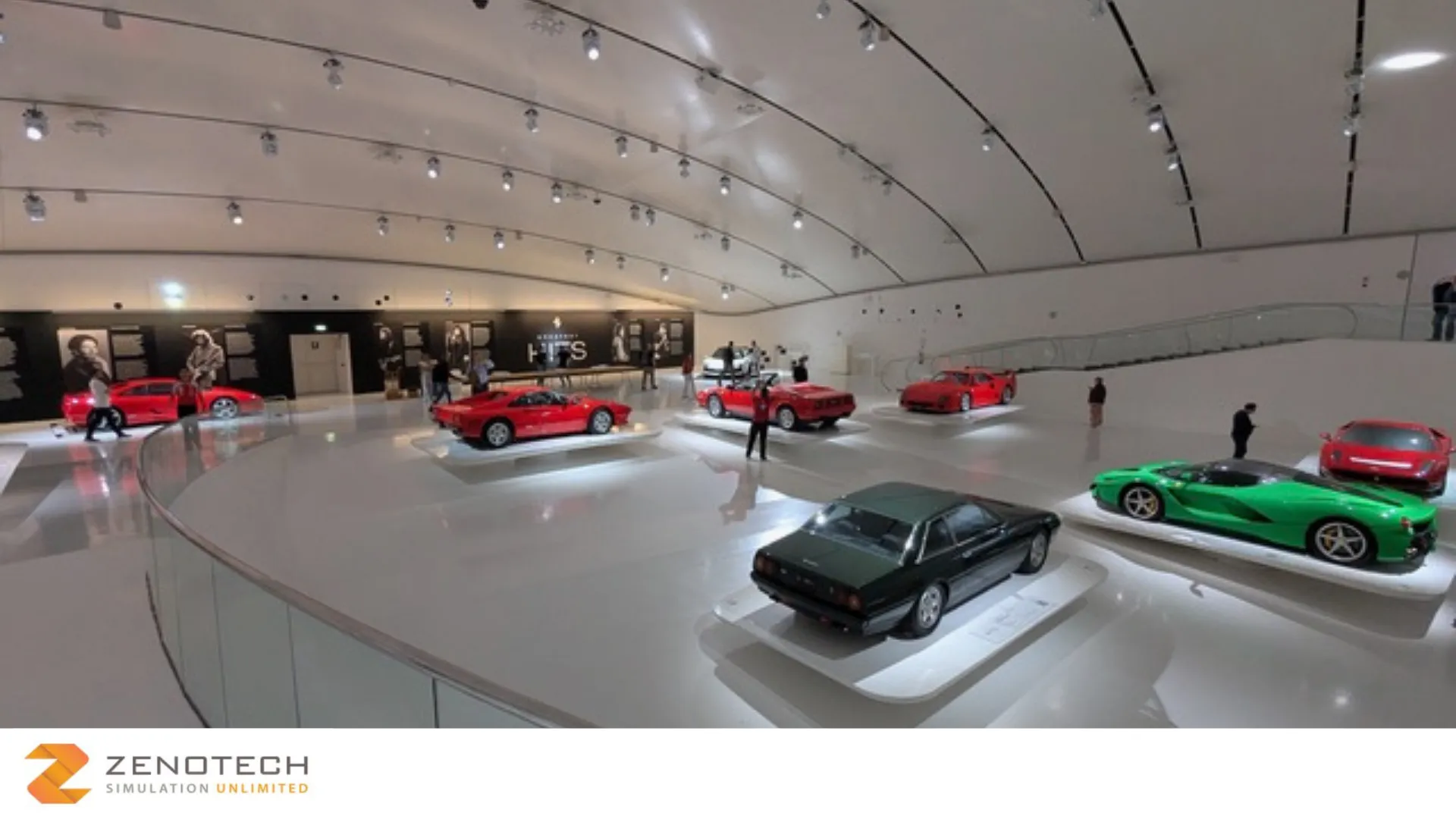
And, of course, no visit to Bologna would be complete without a trip to the Ferrari Museum!
Oliver and the Zenotech team are already looking forward to AutoCFD6, where we hope to share our HiPer findings and contribute to the ongoing development of automotive CFD.